
Here’s What The Fed Will Say Today
We already published a comprehensive FOMC preview of what is largely expected to be a dovish pause when the Fed reveals its decision at 2pm ET today in what some have dubbed the “least anticipated Fed meeting in recent history“, and in which the Fed officials are expected to leave interest rates steady this week after three straight rate cuts (which coincided with the last few months of Biden’s presidency), giving themselves more time to lower inflation and to assess how President Donald Trump’s policies will affect the economy.
But for those who missed it and/or are strapped for time, here is a snapshot of what we the Fed is likely to say today.
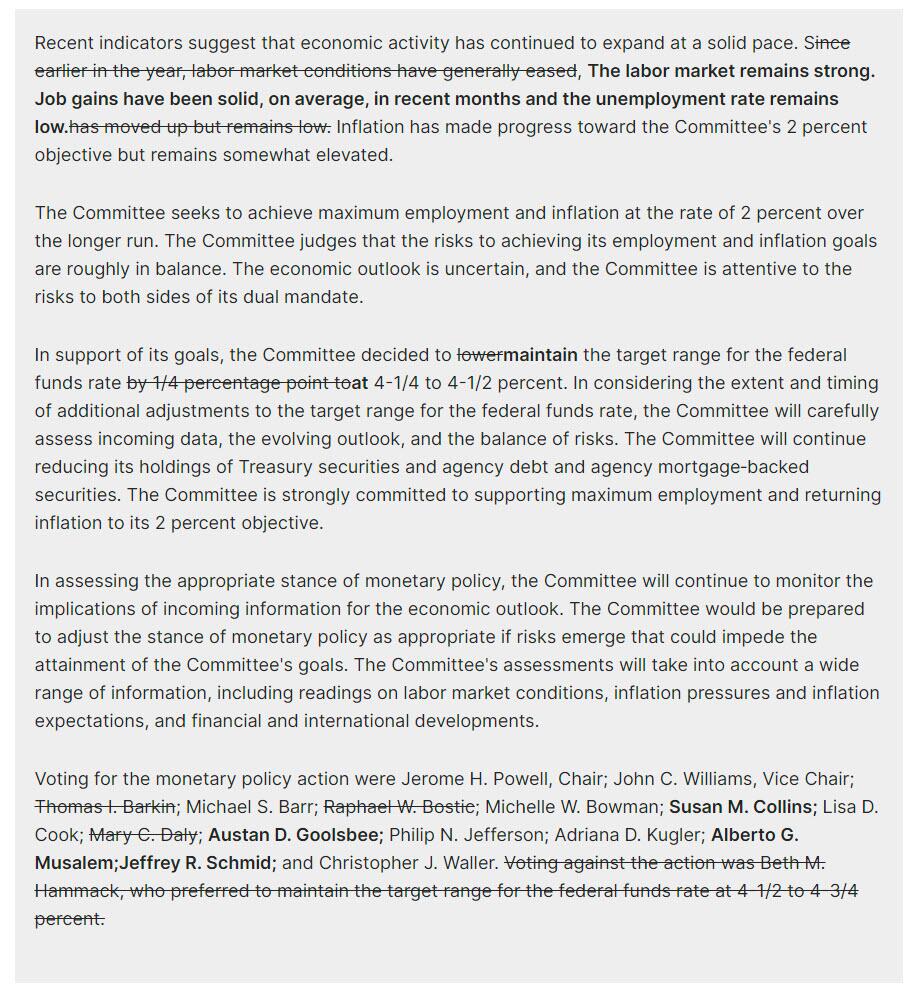
Fed watchers don’t expect the FOMC to make many changes to their post-meeting statement. The current wording referring to the “extent and timing of additional adjustments” already gives policymakers flexibility to change their approach, as needed, based on what happens with the economy, according to Gregory Daco, chief economist for EY. Morgan Stanley believes that the Fed will underscore the strength of the labor market – especially after the unexpectedly strong December payrolls print – with unemployment still low, while keeping the rest of the statement largely unchanged, which is why the Fed will pause as the following proposed FOMC statement redline from the bank shows.
Press Conference
With little tangible variance expected in the statement, all attention will be on Powell’s press conference, where Goldman’s economists will listen for any hints about three key questions.
First, would further decline in inflation be enough to reassure the more hawkish participants, who were likely concerned about the lack of progress on year-on-year core PCE inflation in 2024H2, and open the door to rate cuts?
Second, how strongly does the leadership feel that the current level of the funds rate is still “meaningfully restrictive”—Powell said this four times in December—and not an appropriate stopping point?
Third, how does the FOMC intend to navigate uncertainty about potential tariff increases now and their impact on prices, GDP, and financial markets later?
Future Adjustments
Powell will almost certainly be pressed by reporters over how he and his colleagues are factoring Trump’s policies and proposed plans into their outlooks for the economy. Fed officials are not due to release updated forecasts until their March policy meeting.
The Fed’s Path Forward
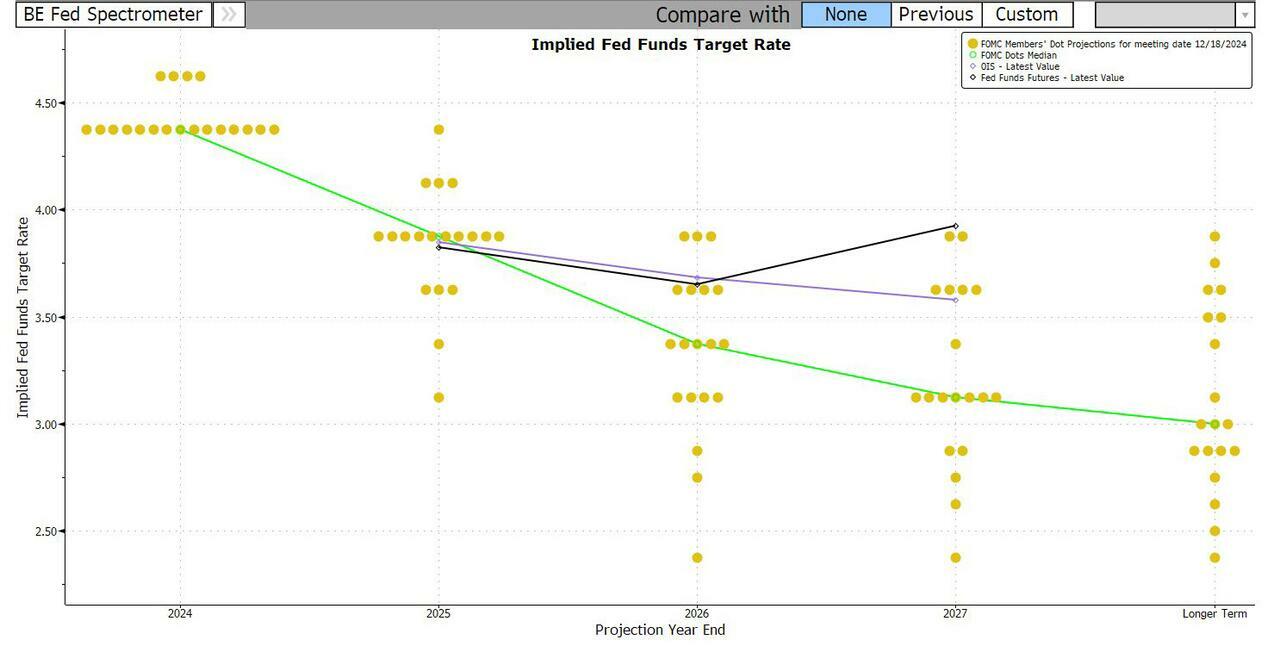
While the market consensus is for just over 1 rate cut for the rest of 2025, Goldman’s baseline forecast calls for two 25bp rate cuts this year in June and December and one more in 2026 because the bank remains confident that inflation is headed back toward the Fed’s 2% goal and—following the historical precedent outlined above—do not expect tariffs to restrain the FOMC from cutting indefinitely. But the bank admits that it is hard to have great confidence in the exact timing of cuts, both because its economic forecast—lower inflation and a healthy labor market—would not make the decision to cut obvious, and because even after a look back at the 2018-2019 experience it is still hard to know how the FOMC will choose to navigate possible tariffs this time.
Goldman is, however, far more confident that market pricing as a probabilistic statement about possible Fed paths in coming years is too hawkish. The bank sees the 4% funds rate that the market is pricing over the next few years as the very top of the range of where the FOMC might plausibly see neutral and be willing to leave policy on hold indefinitely. Because there is always some chance of large rate cuts in a potential recession, for 4% to make sense as an average outcome, one must also see a meaningful chance of hikes. Here Goldman says that the market 35% implied probability of a rate hike over the next year is too high, and speculates that market pricing presumably reflects the widespread view that the combination of higher tariffs, fewer low-wage immigrant workers, and tax cuts will be inflationary and therefore hawkish. Directionally this makes some sense, but Goldman thinks the impact is much smaller and the risks are more two-sided than thought. Additionally, Goldman does not expect further declines in immigration flows
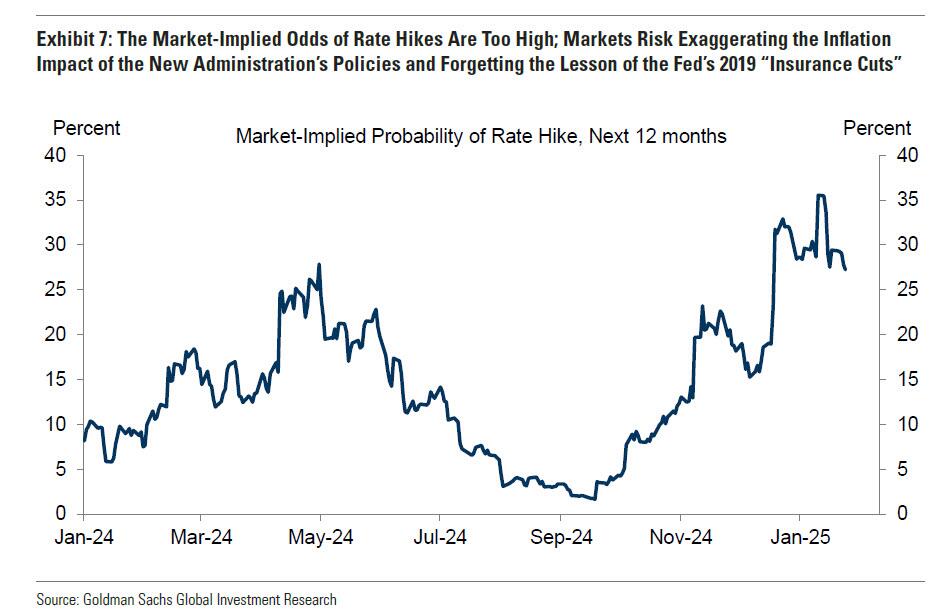
According to Goldman, only tariffs could move the needle significantly on inflation. While they could restrain the FOMC from cutting, Fed officials would set a very high bar to hike from a starting point they already see as meaningfully above neutral in response to a one-time price level increase. And more importantly, any tariffs that raised inflation enough to even open a discussion about hiking would quite likely also unsettle the equity market, which in itself would be deflationary and spark rate cut discussions. As noted above, when fairly modest tariffs rattled the equity market in 2019, the Fed ultimately delivered three “insurance cuts.”
Tariff Response
Powell will be pressed by reporters over how he and his colleagues are factoring Trump’s policies and proposed plans into their outlooks for the economy. Fed officials are not due to release updated forecasts until their March policy meeting. But minutes from the December gathering showed “a number” of participants included placeholder assumptions about Trump’s potential plans in their economic projections and “almost all participants” said the upside risks to inflation had increased. Investors will also want to hear more from Powell on the so-called “neutral rate,” or the level at which the Fed is neither juicing nor cooling the economy. Officials have been raising their estimates for neutral over the past year. If many policymakers believe interest rates are near that point, it suggests not only a slower pace of reductions ahead, but fewer total cuts as well.
Reporters will also ask Powell for more clarity on what officials will need to see before they lower rates again, and, conversely, what could force them to consider a rate increase. After a blockbuster December jobs report, economists at Bank of America said they believed the central bank’s next move might be a hike.
Political Pressure
According to Bloomberg, Powell may also be asked to respond to Trump’s latest jabs at the central bank. “I think I know interest rates much better than they do, and I think I know it certainly much better than the one who’s primarily in charge of making that decision,” Trump said Jan. 23, in an apparent reference to Powell.
Powell has in the past deflected or ignored Trump’s comments on monetary policy but the remarks, coming in Trump’s first week back in office, suggest the Fed chief could face more pressure than ever before from the new administration.
“The Fed will likely have to deal with Trump’s efforts to influence monetary policy, both through appointments and potentially through other efforts to exert more sway on the institution,” Michael Feroli, chief US economist for JPMorgan Chase & Co., wrote in an email note Friday. He predicted this week’s meeting will be “a boring start to a tumultuous year for the Fed.”
Much more in our full FOMC preview available here.
Tyler Durden
Wed, 01/29/2025 – 13:05
https://www.zerohedge.com/markets/heres-what-fed-will-say-today-0