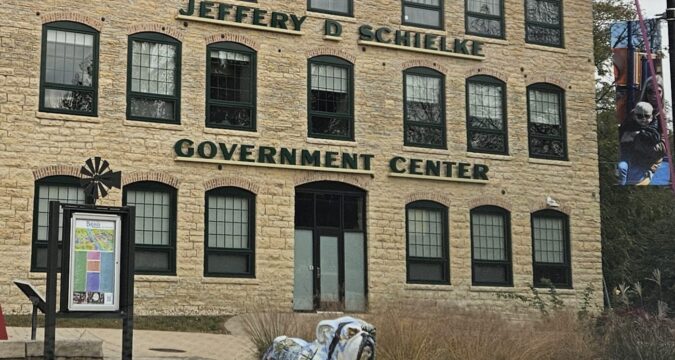
Joining a flurry of other municipalities, Batavia’s City Council is considering drafting an ordinance that would ban federal immigration enforcement on city-owned property, as a federal immigration crackdown continues in Chicago and its surrounding suburbs.
The issue was discussed at the Batavia City Council’s Committee of the Whole meeting last Tuesday, at which dozens of residents addressed the council, the vast majority speaking in support of such an ordinance.
At the meeting, Batavia City Administrator Laura Newman explained that the idea was prompted by requests from several aldermen, and that city staff has looked at similar ordinances in nearby municipalities as they consider similar legislation in Batavia.
The legislation cropping up in municipalities in Chicago and its surrounding suburbs is a response to President Donald Trump’s Department of Homeland Security’s “Operation Midway Blitz,” a surge of immigration law enforcement in the area that began almost two months ago.
Since then, Chicago Mayor Brandon Johnson established Chicago city property as “ICE-free” zones in early October, and municipalities like Evanston, Waukegan, Carpentersville and North Chicago have followed suit with similar measures. Nearby Elgin is also considering prohibiting U.S. Immigration and Customs Enforcement agents from using city property for detentions and other purposes.
Newman said the idea was prompted by requests from several aldermen. Based on comparison of other municipalities’ recently-passed legislation, she noted that such measures focus on the physical use of public property, and often specify that the restriction refers only to civil immigration enforcement, not criminal enforcement, and would not bar federal agents from entering city property with a valid judicial warrant.
The proposed ordinance’s text had not yet been established and was not outlined at the Oct. 28 meeting, but the idea generated considerable support among the council and residents who spoke at the meeting, though there was some discussion of its implementation and enforceability.
The City Council ultimately voted at the meeting in support of drafting an ordinance addressing federal immigration enforcement on city property. But this is not a final vote, Ald. Jim Fahrenbach emphasized at the meeting, and the city will be continuing to discuss the matter.
But, before last Tuesday’s vote, council members and residents spoke at length about their concerns over the effects of federal immigration enforcement in the area, and their thoughts on what such an ordinance would look like.
Ald. Kevin Malone said he supported the idea, but emphasized that the focus of the proposed ordinance would be what the city can do.
“We are not talking about immigration policy,” Malone said. “I know we think we are but we really are not. We’re talking about what the city can do with its property and its engagement with federal enforcement.”
As for the rationale behind such a measure, Malone pointed to concerns about safety amid the current immigration crackdown.
“When people are afraid to leave their homes, to go to the library, go to City Hall, to report to the police department crimes that have occurred, we are all less safe,” Malone said.
He called the possible ordinance one of the “small things that we can do to really make our town a little more inclusive and a little bit better.”
Following Malone’s comments, around 40 speakers addressed the ordinance at the meeting, which stretched over more than three hours. Nearly all of them expressed concern about the recent federal immigration enforcement activity and spoke in support of the city enacting a measure banning federal agents from operating using city property.
Many spoke of Batavia as a diverse city, and several pointed to the city’s Peace on Earth sign on the famous Peace Bridge over the Fox River.
“Diversity and inclusion are hallmarks of the city of Batavia,” Batavia resident Tom Freeman said at the meeting. “Always have been, hopefully always will be.”
Another Batavia resident, Brian Murphy, said the measure will address a “threat” to the community, and pointed to Batavia’s values.
“Our Batavia prides itself and continually and actively positions and promotes itself as a diverse, eclectic and welcoming community,” Murphy said at the meeting. “This was a key reason that our family moved to and has lived in Batavia for over 21 years. These are our core strengths as a community.”
Several of the residents who spoke described fear in the community amid the federal immigration crackdown.
Danielle Sligar, who said she is Latina and comes from an immigrant family, pointed to a petition that was circulated in the community, garnering over 700 signatures as of Friday.
“I need it to be understood that … there are hundreds and hundreds of other constituents that are in full support but did not sign,” Sligar said on Tuesday. “Not because they don’t believe in this, not because they aren’t watching this meeting and the actions that you’re going to take, but because of what this petition speaks to — the fear.”
And Matt Sperry, an attorney, said he’s noticed fear in the community among his clients.
“I have clients, many of them, they’re just terrified even coming out of their homes,” he said. “And I can’t blame them. I mean, you turn on the news for five minutes, you hear about people getting hauled out of their cars in West Chicago.”
Similarly, Matt Benning, who teaches at Northern Illinois University, said he’s seen similar fear among his students.
“My students, brown or white, are scared. They’re either scared for themselves or they’re scared for their friends,” Benning said. “This does not bode well for the classroom.”
“When they are distracted and they are scared, they show up less, they are paying attention less,” Benning said.
Several of the aldermen also expressed their support for a proposed ban on federal agents conducting immigration enforcement on city property, though some raised questions about how the ordinance, if passed, would be enforceable.
“It is true people do not feel safe, and that should be concerning to us,” said Ald. Leah Leman. Ald. Alice Lohman also spoke in support.
Like some of the residents who spoke at the meeting, Mayor Jeff Schielke chimed in about Batavia’s history in expressing his support for the proposed ordinance.
“Batavia’s got a very, very proud history here, and I think tonight was just another proud chapter to add to that proud history,” he said.
Ald. Christopher Solfa raised questions about how the ordinance would differ from the regulations in the state’s Trust Act, which generally prohibits state and local law enforcement from getting involved in deportation efforts with U.S. Immigration and Customs Enforcement or other federal policing agencies dealing with immigration matters.
Ald. Alan Wolff said the city needs to be careful not to duplicate what’s already included in the Trust Act, but that the city is aiming to “state and support what we think our community needs to hear,” whether or not it’s enforceable.
“Legislation needs to be impactful and enforceable,” Ald. Matthew Anderson added during the meeting about the measure.
Ald. Tim Lanci asked how the ordinance would change the city’s actions if, for example, there was a staging of federal agents on its property, to which Newman noted that the main difference or addition from the measures passed elsewhere that the city looked at was that it would obligate city employees to report city property being used for civil immigration enforcement operations or staging.
But, like Wolff, Ald. Abby Beck suggested that the matter wasn’t just about enforceability.
“I want to act on whatever piece of legislation — symbolic, effective or not — that builds trust, that makes our residents feel safer,” she said.
And, though Batavia City Council members noted that the regulation would only apply to property owned by the city, Ald. Jennifer Baerren suggested the matter be taken further, encouraging the community to put pressure on the other public bodies in Batavia, and surrounding communities, to enact similar measures.
“That way we create a big, huge line that (is) supporting our neighbors,” Baerran said, “and that our neighbors feel like they can go to the other communities and shop and be free.”
mmorrow@chicagotribune.com