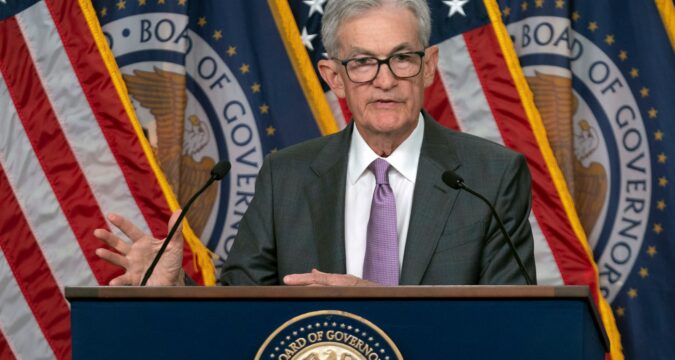
While most of the 335 million Americans will be sifting through the election results today, the dozen members of the Federal Reserve’s Federal Open Market Committee will be meeting today and tomorrow to decide what to do about interest rates. Lower them they must to keep the economy going strong and make it easier for people to finance homes and borrow for other purposes.
The benchmark 4.9% rate is too high and needs to come down.
Fed Chair Jay Powell and the other six Fed governors, joined with the presidents of five of the 12 regional banks (the New York Fed president is uniquely always on the FOMC) have done an admirable job tamping down inflation, which hurt so many with punishing rising prices that topped 9% in June 2022, the worst in more than 40 years.
The inflation spike slashing into paychecks followed the gush of government spending to keep the country afloat during COVID, a necessary expense. But a new problem was created. And a new remedy was required.
To kill the inflation, Powell and Fed jacked up interest rates, again and again and again for a total of 11 rate hikes, landing at 5.3%. It hurt, as money got tighter and tighter, but it succeeded and inflation was tamed and now is time for the easing of interest rates, which is the price of money. At their last FOMC meeting, in September, they reduced rates substantially, down to 4.9%, but they have to keep going.
Happily, the Commerce Department reports GDP growth is robust and the U.S. jobless level is low, at 4.1%, making for an overall economy in excellent shape. But interest rates are still just too high.
Lowering the Fed benchmark tomorrow will be a boost of confidence that more rate cuts are coming.
The Fed is designed to be insulated from elections, with the governors serving 14-year terms. The rate cut that they must announce tomorrow had to occur regardless of which party won at the ballot box yesterday, as it should be.
There were voices out there when the Fed started cranking up the interest rates that instead of just curbing inflation as intended, the result could have been a recession, hardly a good tradeoff. Not so. Powell was right. He was first appointed Fed chair by Donald Trump in 2018 and then having served during the financial chaos of COVID and the economic shutdown, was reappointed by Joe Biden in 2022.
Both presidents, one Republican and one Democrat, made a smart pick in Powell. Powell is going to continue to be smart.
Typically, the Fed will reduce interest rates to goose a slow-moving economy. The economy is just fine as the stats show, and the central bankers are simply using their monetary tool to restore the interest rates back to where they were before the inflation-busting.
So high growth, low inflation, low unemployment and soon, lower interest rates. About as good as an economy gets for this country or for any industrialized country. The new president and the new Congress taking office in January have to keep humming the machine that Powell has delivered to them to benefit all Americans.
Powell and the nonpartisan Fed made it look easy to get it just right; we’ll see in the new year how the political players do.