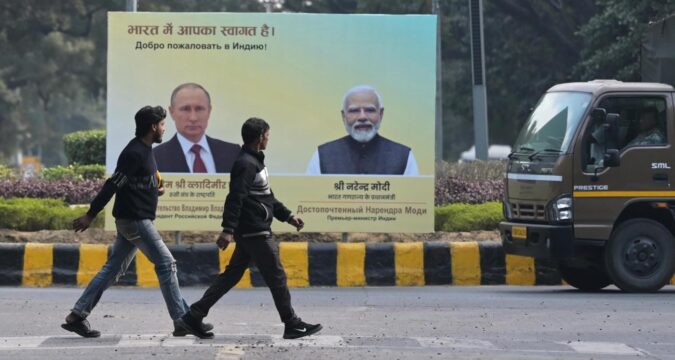
Russian President Vladimir Putin’s visit to India is noteworthy. The sheer energy of the long-term Russian dictator is significant, given persistent rumors about his health. Additionally, current India-U.S. frictions provide collaborative opportunities for both Moscow and New Delhi.
Prime Minister Narendra Modi is repressive. This includes hostility to India’s religious minorities and repression of public criticism. India continues to purchase oil from Russia, despite an international embargo in reaction to the invasion of Ukraine.
The visit resulted in economic agreements, but no great breakthrough. During the Cold War, India was often friendly with the Soviet Union.
“The Great Game” refers to the historic competition between Great Britain and Russia for strategic influence in South Asia.
The same logic broadly applies today. Asia-Europe trade routes through South Asia have been important since ancient times. Beijing is acutely aware of this dimension.
Additionally, sectarian conflict is deeply rooted in the region.
In 2012, Taliban attackers shot young Malala Yousafzai of Pakistan in revenge for her advocacy of education for females. She survived and has become a vital international symbol of courage. Vital Voices Global Partnership, a nonprofit organization to empower girls and women, established the Malala Fund.
In early 2016, militants raided an Indian military base. The United Jihad Council, a Kashmir group, claimed credit. Simultaneously, terrorists attacked an Indian consulate in Afghanistan.
In 2019, an attack in disputed Kashmir killed 40 Indian police. Periodic violent clashes continue.
Global media emphasis on incidents involving U.S. military ally Pakistan reflects the region’s strategic importance, but overshadows democratic progress. In September 2013, Mamnoon Hussain succeeded Pakistan President Asif Ali Zardari, who did not seek reelection. This was the first peaceful presidential transition in Pakistan’s history.
This somewhat balances the deterioration of long-established political democracy in India.
Pakistan-U.S. relations remain vexed. Pakistan, since the 9/11 terrorist attacks, is important in the continuing struggle against Islamic terrorism. The ability of Osama bin Laden, mastermind of the attacks, to hide in Pakistan raised suspicion that officials there may have been complicit.
Pakistan was not informed in advance of the U.S. SEAL Team 6 raid that killed him.
However, Pakistan has been a generally reliable ally of the West, a point often overlooked in media commentary. The British-trained military is extremely capable.
In the 1950s, Pakistan joined both the Central Treaty Organization (CENTO) in the Middle East and the Southeast Asia Treaty Organization (SEATO). Pakistan and Britain were distinctive as members of both alliances. These alliances are gone, but geostrategic interests continue.
Significantly, India and Pakistan have nuclear weapons.
The Quadrilateral Security Dialogue (The Quad), established in 2007, substantially revitalized in 2017, involves growing collaboration among Australia, India, Japan and the United States. Important incentives include containing China.
In 2023, despite shortcomings of the Indian regime, Modi was accorded a state dinner by President Joe Biden and addressed a joint session of Congress.
At that time, India’s leader demonstrated astute diplomacy, including joining a mass yoga exercise on the grounds of the United Nations.
Respect accorded to Modi by the Biden administration in no way indicated approval of the unfortunate and ugly aspects of his government, but rather a realistic awareness of the undeniable importance of the South Asia region.
Reasonable relations with New Delhi are essential to further stability in that volatile part of the world, especially given the alliance with Pakistan.
A cooperative stance regarding India reflects political realities. The international strategic situation remains unchanged and should guide U.S. officials in their work today.
Arthur I. Cyr is author of “After the Cold War – American Foreign Policy, Europe and Asia” (Palgrave/Macmillan and NYU Press).
Contact acyr@carthage.edu
https://www.chicagotribune.com/2025/12/09/arthur-i-cyr-column-putin-india/