Tropical Storm Erin has changed little in the past 18 hours but is forecast to intensify into a hurricane on Friday as it tracks just north of the Caribbean islands and begins a turn to the north, according to the latest update from the National Hurricane Center.
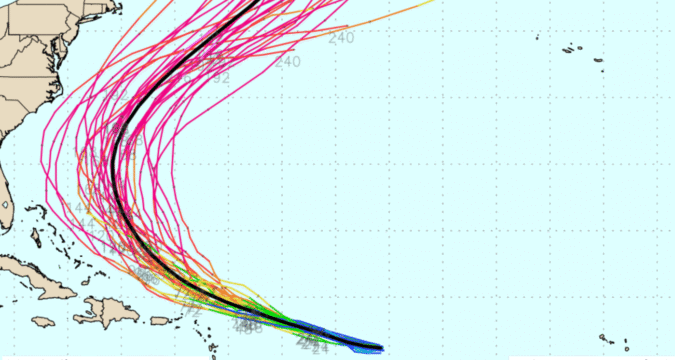
All week, the forecast models have been predicting Erin will veer away from the U.S. east coast, and forecast models have come into strong agreement that the arc north will begin late in the weekend or early next week.
By then, Erin is forecast to be a major Category 3 hurricane with maximum winds between 115 and 125 mph.
“Gradual strengthening is forecast during the next day or so, with more significant intensification possible on Friday and Saturday,” the Hurricane Center said in its Thursday morning update.
The path of Erin will take it close enough to the Caribbean to bring topical storm-force winds, heavy rainfall and high surf to Puerto Rico and the Leeward Islands.
Here’s the latest forecast path of Tropical Storm Erin, according to the National Hurricane Center’s 5 a.m. Thursday update.
“Erin could move close enough to the northern Leeward Islands, Virgin Islands, and Puerto Rico over the weekend to produce some impacts on those islands. However, the magnitude of those impacts is still not known,” the Hurricane Center said.
The hurricane center’s cone of uncertainty was just north of the Dominican Republic and Puerto Rico, according to the center’s Thursday morning update. Tropical-storm-force winds could arrive at the island as early as 8 p.m. Saturday. High winds could spur power outages.
Potentially life-threatening swells from Erin will begin affecting the eastern Caribbean, Virgin Islands and Puerto Rico this weekend, the hurricane center said. These swells are likely to cause life-threatening surf and rip current conditions.
As of Wednesday afternoon, Erin was 990 miles east of the Caribbean, moving west at 17 mph with sustained winds of 50 mph. Erin is encountering dry air and mild sea-surface temperatures, which will “keep the small vortex in check,” the hurricane center said.
But warmer waters will eventually fuel strengthening, and forecaster said there is “even greater uncertainty” regarding impacts to the east coast of the United States, and Bermuda next week.
“Bermuda could be soaked with 2 to 4 inches of rain and wind gusts of 60 to 80 mph when Erin passes by the island next week,” said AccuWeather lead hurricane expert Alex DaSilva.
Erin would be the first Atlantic hurricane of the season and is the fourth tropical storm.
The average date for the first hurricane is Aug. 11.
A subset of scenarios show a threat to the east coast, but even without a direct strike, the coast still may feel marine effects. “Erin will churn up rough surf and dangerous rip currents along the Atlantic coastline from Florida all the way north to Maine starting this weekend into next week,” DaSilva said Tuesday. “Beach erosion is possible in some areas. A major hurricane in the open Atlantic can produce very rough surf that will impact beaches hundreds of miles away. Hazardous beach conditions are likely across parts of the Caribbean, Bahamas and Bermuda.”
If the storm stays weak, then strengthens near the Bahamas, it could affect the U.S. East Coast. A South Florida impact would be the least likely scenario: As of Tuesday, most forecast tracks — known as the “spaghetti models” — show the turn coming well before reaching the U.S. coast. But many of those tracks have moved that turn a bit closer to the U.S. than previous runs.
Elsewhere in the tropics
An area of low pressure has formed in the southwestern Gulf, near Honduras and Nicaragua. It is expected to move west-northwest across the water Thursday, where conditions are slightly more favorable for it to develop, forecasters said.
A system is expected to move across the southwestern Gulf overnight on Thursday, the National Hurricane Center said.
Forecasters expect it to move over northeastern Mexico by late Friday, which would end any chances for it to develop.
It has a 20% chance of developing in the next two to seven days, the hurricane center said.
https://www.chicagotribune.com/2025/08/14/tropical-storm-erin-hurricane-track-us-coast/