An upcoming study of the Waukegan River and the ravines flowing into it — to be done by the city, the Great Lakes and St. Lawrence Cities Initiative, and the National Fish and Wildlife Foundation — has the potential to impact cities in both the United States and Canada as far east as the Atlantic Ocean.
With the five Great Lakes containing 21% of the world’s fresh water, Johathon Altenberg, the president and CEO of the Great Lakes Initiative, said they need to be protected from potential problems from the environment and climate change.
Altenberg said improving the 4.2 miles of the Waukegan River system will likely have a lasting impact not just on northeast Lake County, but the entire ecosystem of the Great Lakes and St. Lawrence River in both countries.
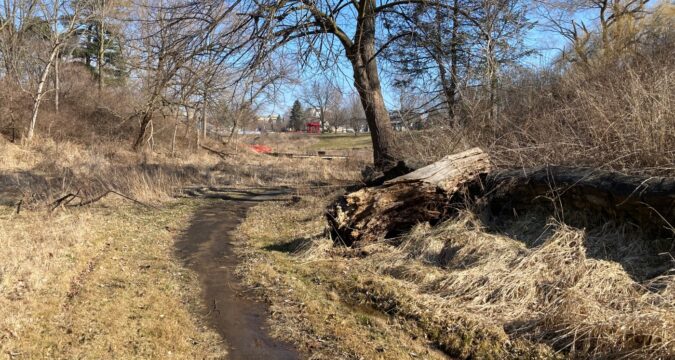
Streams like this one, that eventually flow into the Waukegan River and Lake Michigan, will be analyzed in an engineering study that will start by Sept. 1 to improve the ecological condition of the area. (Steve Sadin/For the Lake County News-Sun)
“If we are not prepared to protect our share of 21% of the world’s fresh water in our region, Waukegan and nearby cities will not be ready for the growth period which will come,” Altenberg said. “This is about protecting the way we live. This is for the next generation and the generations to follow.”
Waukegan plans to start the engineering design project by Sept. 1 to restore and enhance 4.2 miles of the Waukegan River ravine corridor which flows into Lake Michigan to determine the work necessary to deal with erosion, infrastructure, climate change, the environment and more.
Labeled the Waukegan River Ravines Corridor Improvements Project, the effort will design strategies to stabilize eroding ravines, remove invasive species, enhance native habitat and improve recreational trails. Some trails already exist in parks that abut the ravines.
Waukegan Mayor Sam Cunningham, who chaired the Mayor’s Water Equity Commission of the Great Lakes and St. Lawrence Cities Initiative during his first term, reengaged with the organization when he returned to office in May. Building partnerships is important for the city, he said.
“Rebuilding Waukegan requires partnerships,” Cunningham said. “With me being involved again, and this in the pipeline, will only further our goal of rebuilding Waukegan. We are working with partners who can help our vision.”
Funded by a $250,000 grant from the National Fish and Wildlife Foundation to Waukegan via the Great Lakes and St. Lawrence Cities Initiative, Altenberg said it will enhance the effort to adapt to climate change, flooding and erosion in the area.
Examining conditions along the Waukegan River near downtown is part of an engineering study that will assess 4.2 miles of the ravine and river system to identify erosion and other issues. (Steve Sadin/For the Lake County News-Sun)
Daron Terfehn, a special project analyst for the city of Waukegan, said the Waukegan River is a watershed stream that brings rainwater from the ravines around the city into Lake Michigan near the harbor. The area incurred a lot of erosion in the past.
“A lot of things have been dumped in the ravines over the years,” Terfehn said. “Everything (there) flows into Lake Michigan. It affects the salmon, the trout, everything that’s in the lake.”
Before projects can be discussed with potential partners like the Waukegan Park District and the Lake County Stormwater Management Commission, Terfehn said the results of the study are essential. He estimates it will take approximately a year.,
“Much of the land is private property,” Terfehn said. “Some belongs to the city and some to the Park District where it touches their parks. Once we have an idea of what we have to do, we can work with the Park District and stormwater management to do projects together.”
When Cunningham began his second term, Altenberg said the mayor quickly took a leadership role again with the Great Lakes Initiative organization. He is now the co-chair of the Western United States Region which includes Illinois, Michigan, Wisconsin, Minnesota and Indiana.
https://www.chicagotribune.com/2025/08/11/waukegan-river-ravines/