
Powdery landscapes, delicious holiday foods, and traditions rooted in alpine culture: Christmas in Switzerland is more beautiful than any postcard.
Here in the heart of Europe, the Advent season is especially magical. The holidays come with unique traditions in Swiss towns and villages scattered among the Swiss Alps. I would even argue that due to its sheer diversity yet small scale, Switzerland offers a concentrated version of all that makes Christmas so special.
Christmas in Switzerland is Pure Alpine Magic
Inside this magical snow globe, the Swiss celebrate Advent with twinkling lights, roasted chestnuts, magical illuminations, and centuries-old customs. Because the days of Advent are short and cold, many of the activities take place indoors.
When shared with family and friends, many rituals of the season are more fun: making an Advent wreath, baking Christmas cookies, or stirring in a pot of melted cheese without losing the bread…
Bundled in warm winter coats, hats, and mittens, the Swiss also celebrate the holidays outdoors. In a best-case scenario, Switzerland is already covered by the first snowfall as early as mid-November.
The traditional St. Nicholas Day is more magical when the landscape is covered in white. And strolling through a Christmas market while thick snowflakes fall from the night sky is an unbeatable experience.
I assume you are reading this Christmas in Switzerland guide because you want to learn about the most important Swiss Christmas traditions. You have come to the right place, from recipes for popular Swiss Christmas cookies to listings of Swiss Christmas markets and personal anecdotes. And, of course, I have covered everything you always wanted to know about Swiss Santa, a.k.a. Samichlaus or Père Noël…
Christmas in Switzerland 2026 at a Glance
Short on time? Here are the key dates of the Swiss holiday season in 2026/2027:
Advent Sundays: November 29, December 6, 13 and 20, 2026.
Christmas markets: most of the big markets open between November 19 and 28 and close on December 23 or 24. See all dates in our Swiss Christmas markets list.
December 5–6: Samichlaus (St. Nicholas) visits families and schools, and towns like Küssnacht am Rigi hold spectacular processions.
December 24 (Thursday): Christmas Eve, the main family celebration with dinner, the Christmas tree and presents. Shops close early.
December 25 (Friday): Christmas Day, a public holiday in every canton.
December 26 (Saturday): St. Stephen’s Day, a public holiday in most cantons.
December 31 (Thursday): New Year’s Eve with fireworks over the lakes, and the Silvesterchlausen in Appenzell Ausserrhoden.
January 2, 2027 (Saturday): Berchtoldstag, a public holiday in many cantons.
January 6, 2027 (Wednesday): Three Kings Day, celebrated with a Three Kings cake.
January 13, 2027 (Wednesday): “Old New Year’s Eve,” when the Silvesterchläuse make their rounds once more.
From A to Z, here are some of the most significant Christmas in Switzerland traditions:
Advent Calendars and Windows
One of the joys leading up to Christmas is the 24-day countdown. The journey is the destination for Advent calendars, a popular thing for children of all ages. From December 1 to 24, they would open a window or present every day, making the countdown to Christmas Eve more bearable.
There are at least three types of Advent calendars I can think of:
Cardboard calendars with 24 little windows;
3D calendars containing little treats or gifts;
Outdoor Advent calendars are scattered among 24 windows in a town, with an additional window lit up every night.
Growing up, my parents would craft all three types of Adventkalendar from scratch. One year, they would decorate our garage window as Winter Wonderland. And they would pack 24 small bags with things like puzzle pieces or Legos for us kids. By the time Christmas came around, all the pieces could be assembled, thus creating a Christmas gift of its own.
Today, Advent calendars of all shapes and sizes can be purchased with little effort. But on the flip side, this day and age has opened new doors the Swiss have never thought of in the past. From luscious lovers’ calendars with erotic surprises to gourmet calendars featuring Swiss artisanal products, there is an Advent calendar for every taste.
Advent Wreath
During the holiday season, Advent is one of the most significant rituals among Christians. On the four Sundays leading up to Christmas Eve, a new candle is lit on the Advent wreath. The circular Advent wreath is traditionally shaped of pine twigs, adorned by four candles, and placed on the dining table.
The tradition of lighting the four candles is a mindful way of counting down the four weeks until Christmas Eve. At the same time, it is also a fairly dangerous ritual. As wreaths naturally dry out over time, dozens of incidents occur every season where they catch fire and burn down entire apartments.
Some community centers offer workshops to make your own Advent wreath. But we recommend picking one up at a local Christmas market instead.
Candle Dipping
Candle dipping is a popular Swiss holiday tradition that takes place in community centers and outdoor stalls. As early as mid-November, anyone can make their own candles by dipping wicks in hot molten wax. The wax is typically available in a variety of colors. While adults like the traditional bee wax, colorful wax allows children to use their creativity to make unique candles.
Candle dipping requires quite a bit of patience. Dipping the wick into the hot wax before the previous layer has entirely dried results in the wax slipping off. Most kids have this experience at least once before realizing they need to slow down.
At a minimum, making a candle from scratch would take two hours. Most people will have several wicks going simultaneously, dipping one as the others are cooling off.
Candle dipping is an important social activity in Switzerland. It brings people together and raises funds for local organizations or charities. Two major places for candle dipping in Switzerland are in Zurich on Bürkliplatz, or in Luzern on Sempacherplatz.
Christmas Eve Traditions
In Switzerland, families celebrate Christmas on the evening of December 24. On the morning of Christmas Eve or the days before, families traditionally cut a fresh tree for their living room.
As Christmas Eve unfolds, the parents would secretly decorate the tree and hide it under a blanket. Only in the evening after dinner is the tree being revealed for the family Christmas celebrations and gift exchange. Many would still light wax candles, but LED lights have become increasingly popular.
There are likely as many individual traditions as there are families in Switzerland. Some may tell the Nativity story, while others walk in the snow or toast with prosecco. From the perspective of our international author, Steph, here are some Swiss Christmas traditions that surprised her.
Christmas Food in Switzerland
Winter brings out the most cheesy dishes in Switzerland. From raclette to cheese fondue, these dishes bring people together and are also popular for Christmas.
In Switzerland, one of the most traditional dishes on Christmas Eve is fondue chinoise. Think hot-pot meets shabu shabu – raw meat is dipped and stewed in a soup pot, then consumed with various condiments and sauces. Another popular dish is something my family would bake: a ham wrapped in bacon and pastry dough called Schinkli im Teig.
For savory and sweet Christmas dishes, look at our Swiss winter foods guide:
Christmas Markets and Other Seasonal Events
Every year, the Christmas markets in Switzerland radiate a magical atmosphere. There are a variety of smaller markets visited by locals, as well as larger markets drawing visitors from an entire region. And a few Christmas markets, such as the ones in Basel, Bremgarten, or Montreux, are the pinnacles of the holiday season that are considered must-sees.
Most Christmas markets have certain things in common, including food stalls selling roasted almonds, gingerbread, or mulled wine. One of the latest foods is the raclette dog, a hot dog filled with melted cheese.
But many markets set themselves apart by offering something unique. There might be carriage rides, illuminations, local customs, vintage merry-go-rounds, tours of historic structures, or choir performances.
The following links point contain the best Christmas markets in Switzerland, as well as related holiday events:
Switzerland Christmas markets guide
Swiss Christmas and New Year’s events
How Montreux rocks the Holiday Season
Here’s what Zürich looks like with Christmas decorations
Christmas Trees in Switzerland
In Switzerland, the most popular Christmas tree type is Nordmann fir (65%), followed by spruce (20%). (Source) Half of the Christmas trees in Switzerland are imported from places as far as Denmark. If you are near Zürich, here is a helpful list of places to cut your own tree to reduce your carbon footprint.
We like the idea of temporarily adopting a Christmas tree; it is more sustainable. Ecosapin or Happy Tree will ship a living tree to your doorsteps during the holidays. Then, after Christmas is over, the tree will be picked up and replanted.
Yet another alternative is to buy a Norfolk Island pine online. This tree resembles a Christmas tree but survives the seasons.
Grittibänz Breadman
The cute Christmas breadman, shaped from sweet Zopf dough and with tiny raisin eyes, is too sweet to eat! But in those early days of December leading up to Swiss Santa Day, the Grittibänz are hawked by bakeries across Switzerland.
In many Swiss companies, it is a tradition for the employees to find a Grittibänz sitting on their desk on December 6. Schoolchildren might receive one from the visiting Santa. And many families who treasure the art of baking will make their own Grittibänz bread men. Here is a recipe to bake your own Grittibänz.
Light Projections and Illuminations
Some cultures have been putting up holiday illuminations for decades. Entire parks or shopping arcades in places like Kobe, Japan, would be decked with colorful lamps during the holidays. Possibly, this was a way of celebrating the holidays, even in places where Christianity is not predominant.
Here in Switzerland, illuminations and light projections are still fairly new. But in recent years, cities like Bern, Lausanne, and Zürich have stepped up. Their large-scale projections of animations have become a tradition.
Christmas in Switzerland has many faces, from the serene starlights in the old town of St. Gallen to the colorful projections on the Swiss Parliament building in Bern.
Rendez-vous Bundesplatz in Bern
Advent in St. Gallen: 700 stars and culinary highlights (event details)
Swiss Santa, Samichlaus, Père Noël, San Nicolao, St. Nicholas
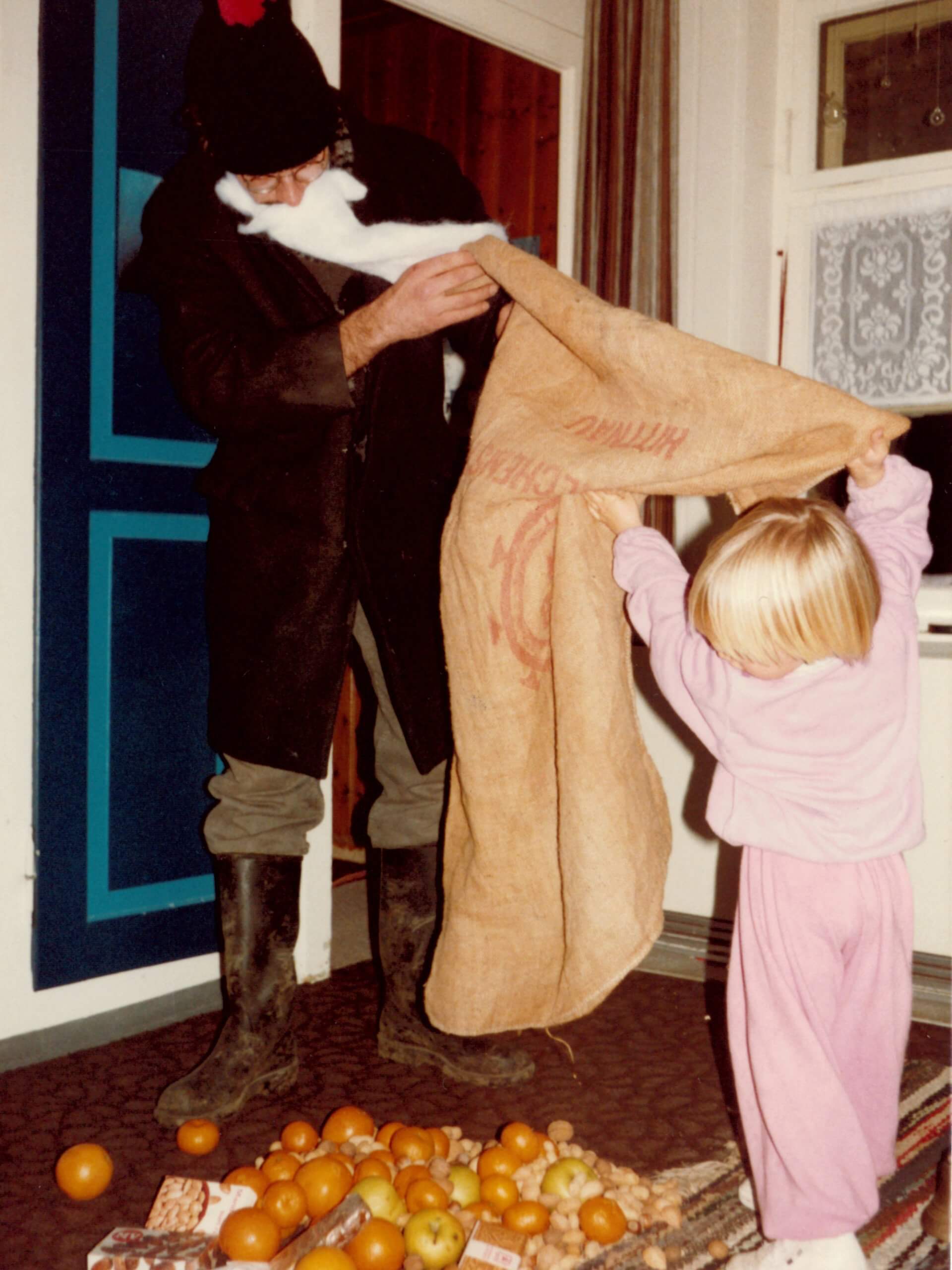
December 6 is an important day for many children in Switzerland: it is the official Swiss Santa arrival. On this day, the hooded Santa emerges from the forest with a donkey. He could not handle those bags full of nuts and mandarines without his helper.
On December 6, Swiss Santa can be spotted as he walks from door to door, greets seniors in elderly homes, or visits kindergartens and schools. A good place to spot Swiss Santa and his sidekick is at one of the many Christmas markets – even if they occur on adjacent dates.
Unlike his American colleague, Swiss Santa is not in charge of gifts. Primarily, he meets with children to tell them stories or let them know what to improve in the coming year. In exchange for rehearsing a Santa poem, kids would get treats from Santa’s bag.
Every season, there are also a handful of extraordinary Swiss Santa happenings. Take the Santarun in Bern, a running event where every participant dresses in a Santa outfit. Copy/paste this concept for a swimming event, the Samichlaus-Schwimmen in Zürich. And finally, there is Clauwau in Samnaun, the annual gathering of Santas from all over the world.
Swiss Santa and his sidekick have different names depending on the language region. Here is what to call them across Switzerland:
Swiss German: Samichlaus and Schmutzli, St. Nikolaus
French: Saint Nicolas and Père Fouettard (Père Noël brings the presents on Christmas Eve)
Italian: San Nicolao and Schmutzli
Learn more about the fascinating Swiss Santa tradition by digging into these posts:
Samichlaus and Schmutzli – Learn how Swiss Santa works
How the Swiss St. Nicholas tradition works
Samichlaus – My first-hand encounter with Swiss Santa
Swiss Christmas Cookie Recipes
Come December, bakeries across Switzerland will switch into cookie-making gear. Be it inside home bakeries or local confectioneries, butter and chocolate are melted, and ovens are running at full steam.
Many Swiss families have the tradition of getting together on the days of Advent to bake Christmas cookies. While stores now sell prepackaged cookie dough, those serious about baking will start from scratch. Using local ingredients is the key to preserving the heritage of family recipes that often go back generations.
Some cookie recipes, such as Zimtsterne (Cinnamon Stars), require some planning. The dough, once mixed, needs to rest for several hours before it can be shaped and baked. Other recipes like Mailänderli are more ad hoc as the dough requires less cooling.
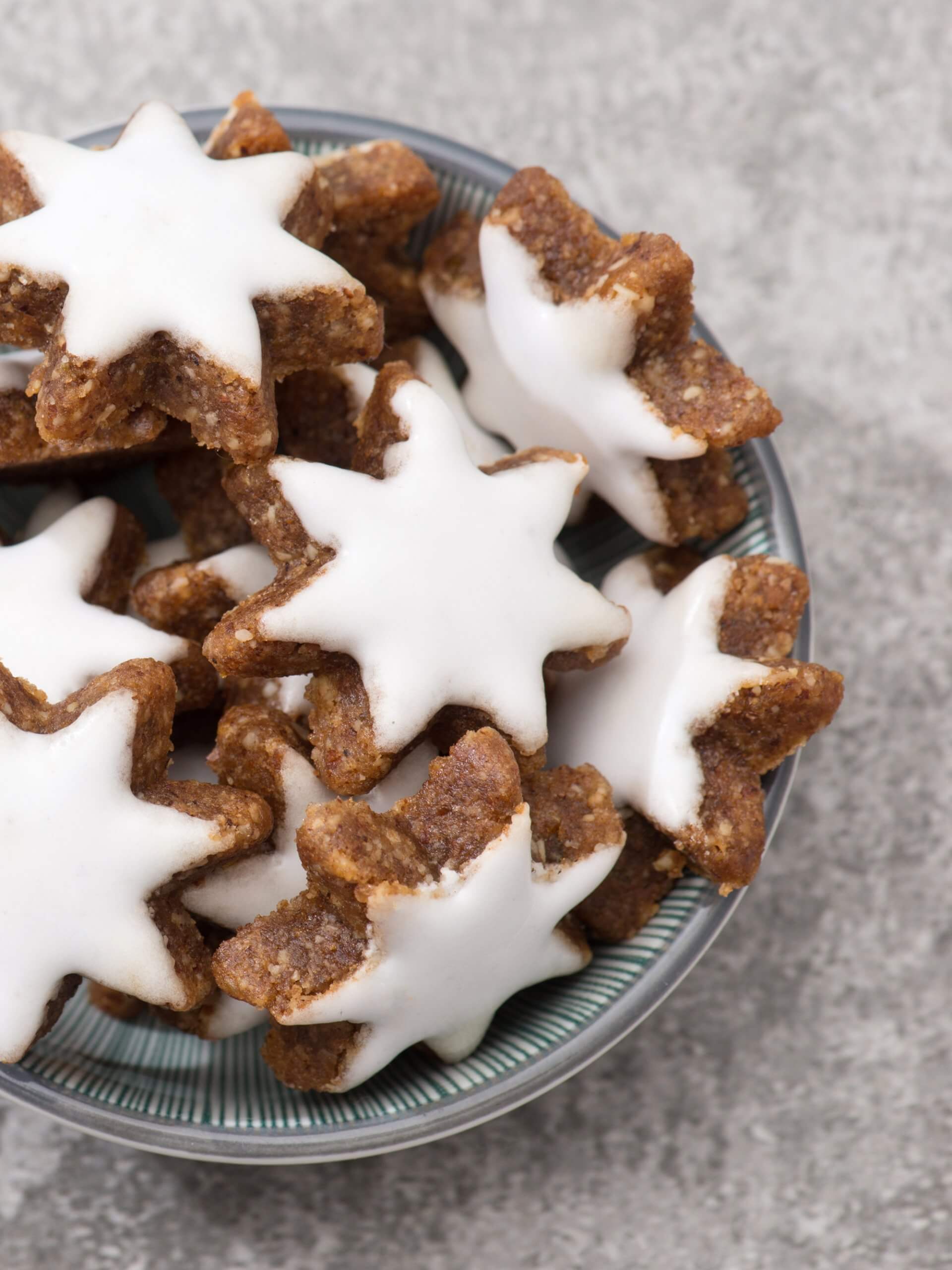
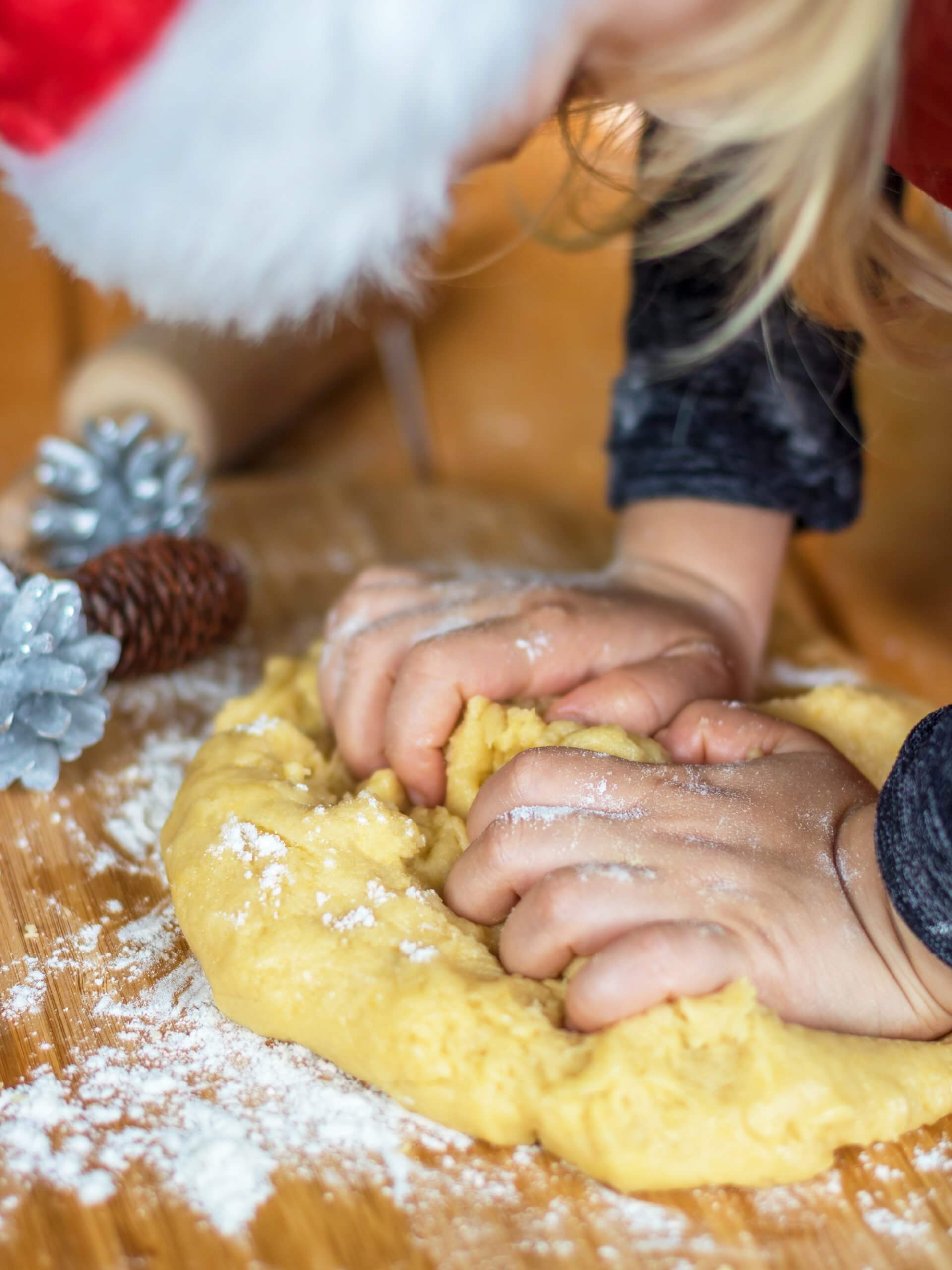
My grandmother would bake about a dozen different cookies each holiday season. She would use tin cans to store each batch carefully. And whenever someone would visit during the holidays, she would proudly serve an assembled platter of Swiss Christmas cookies.
Swiss Christmas Traditions
Like anywhere in the world where Christmas is celebrated, many Swiss families have their own rituals. Generally, Christmas Eve is when most Swiss families eat a delicious dinner, gather around the tree to hand out gifts, and sing Christmas songs. Some will proceed to the church for a midnight service.
From my own perspective, these are the typical Swiss Christmas traditions I remember growing up. Starting in November, some towns and cities offer public candle-dipping stations. For an entire week, I would return to my town’s candle-dipping place every night to finish my bee-wax candles.
For adults, making an Advent wreath is a common November tradition. Since the four candles are lit on the four Sundays before Christmas Eve, the family’s wreath needs to be ready at one point in late November.
Another one of my childhood memories about Christmas in Switzerland is of the Advent calendar. In my young mind, the 24 windows, or little gifts, were an epic build-up to Christmas Eve. Every morning in December, I would jump out of bed to see what the new day had in store.
Fast forward to December 6, when many Swiss children experience another highlight. For weeks, the little ones will have rehearsed their poems. They envisioned the bearded man with his helper in front of their inner eye. And they are ready to meet Samichlaus and claim the goodies in his bag. But when it is crunch time, stage fright is not uncommon…
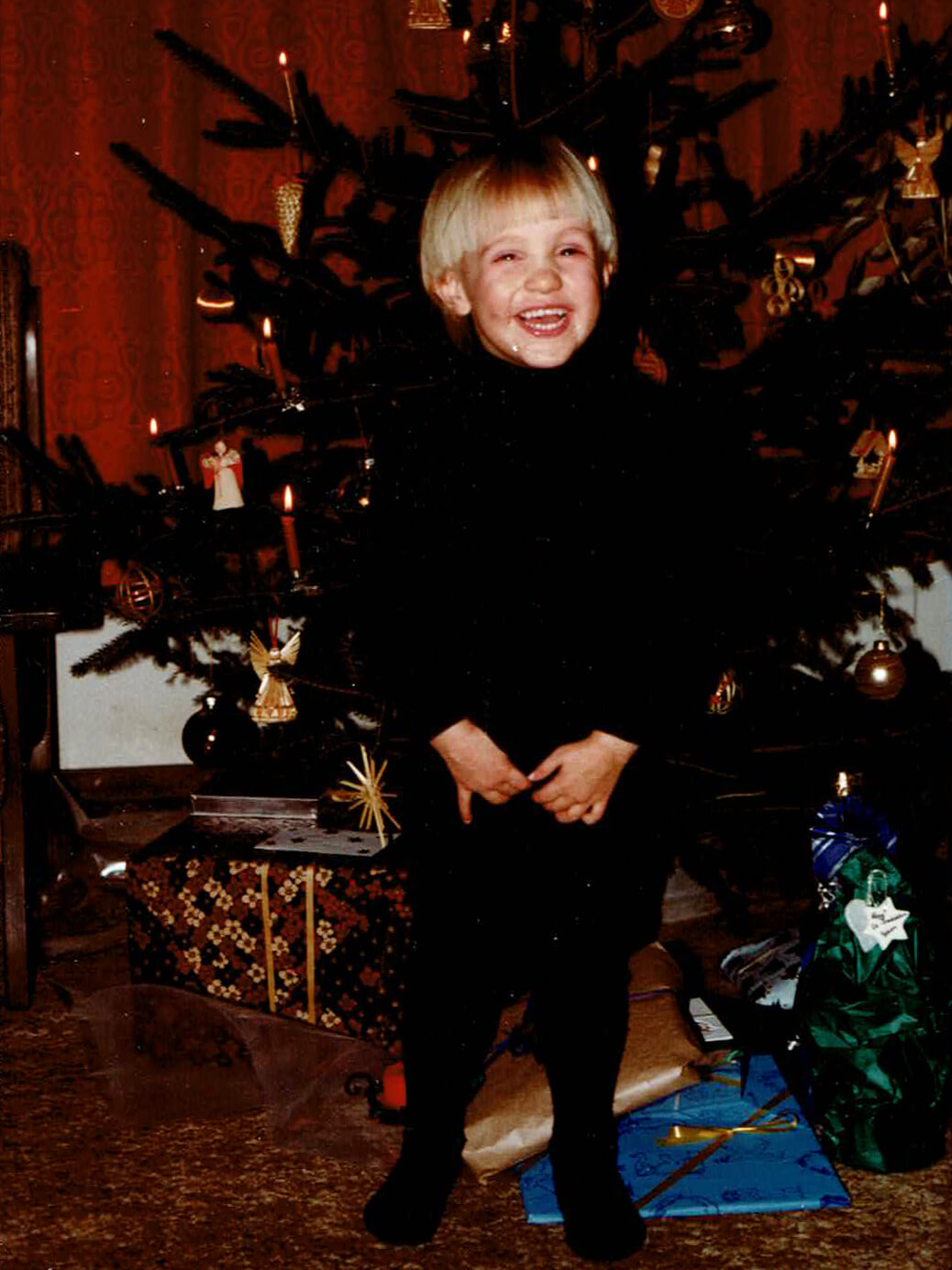
My parents used to decorate the freshly cut Christmas tree on Christmas Eve. My sister and I were not allowed in the room, and the tree was covered with a blanket before we were led back in. Then, after dinner, we would open a window and go for a brief walk as a family. (For some reason, my dad was always lagging behind…)
Then, by the time we returned home, the Christkind angel had magically delivered all the gifts! To our great surprise, the lights on the tree were lit, and Christmas was finally here.
Who Brings the Presents? Christkind, Père Noël and Babbo Natale
In Switzerland, Santa Claus does not deliver the Christmas presents. Samichlaus visits on December 6 with nuts, mandarins and gingerbread, but the gifts under the tree come from someone else, depending on where you live:
German-speaking Switzerland: the Christkind (Christ Child), often imagined as an angel-like figure, brings the presents on Christmas Eve.
French-speaking Switzerland: Père Noël, a close relative of Santa Claus, fills the stockings and the space under the tree.
Italian-speaking Ticino: traditionally Gesù Bambino (the Christ Child), and increasingly Babbo Natale.
Presents are usually unwrapped on the evening of December 24 after dinner, not on the morning of December 25. In many families, a little bell rings to signal that the Christkind has been there and the children may enter the room with the tree.
Christmas Public Holidays and Opening Hours
Each canton sets its own public holidays, so the days off differ slightly across Switzerland. Here is what to expect in 2026/2027:
Christmas Eve (December 24) is not an official public holiday in most cantons, but many people take the afternoon off. Shops close earlier than usual, so do your last-minute shopping in the morning.
Christmas Day (December 25) is a public holiday in every canton. Most shops are closed, except some at train stations and airports.
St. Stephen’s Day (December 26) is a public holiday in most cantons, but not in Geneva, Vaud or Jura. In 2026, it falls on a Saturday.
New Year’s Day (January 1) is a holiday everywhere, and Berchtoldstag (January 2) is a holiday in many cantons, including Bern, Lucerne and Vaud.
On public holidays, trains, trams and buses run on Sunday timetables. In December, many shops in larger towns also open on one or two Sundays for Christmas shopping.
Between the Years: From New Year’s Eve to Three Kings Day
The Swiss call the quiet days between Christmas and New Year “zwischen den Jahren” (between the years). Many offices close, and families head to the mountains for skiing and sledding.
On New Year’s Eve (Silvester), cities like Zurich, Lucerne and Geneva celebrate with fireworks over their lakes. In the hinterland of Appenzell Ausserrhoden, the Silvesterchläuse walk from farm to farm with huge bells and ornate headdresses, yodeling and wishing everyone a happy new year. They do it twice: on December 31 and again on January 13, “Old New Year’s Eve” according to the Julian calendar. Find more dates in our Christmas and New Year’s events guide.
The holiday season officially ends on January 6 with Three Kings Day (Dreikönigstag). Families share a Dreikönigskuchen, a sweet bread crown with a tiny king hidden inside one of the buns. Whoever finds it gets to wear the paper crown and be king or queen for the day. Bake your own Three Kings cake.
Winter Treats: Roasted Chestnuts, Candied Almonds and Cheese
Walk through any Swiss old town in December, and you will smell it before you see it: hot roasted chestnuts (Marroni), sold in paper bags at little street stands. Here is why roasted chestnuts are my winter obsession.
At the Christmas markets, look out for freshly candied almonds (gebrannte Mandeln), Magenbrot (spiced gingerbread bites) and mulled wine (Glühwein). You can easily make candied almonds at home. For heartier fare, our guide to Swiss winter foods and our modern Swiss cheese recipes have you covered.
Looking for a Christmas gift for a cheese lover? The recipe book Swiss Fondue by Jennifer and Arnaud Favre has 52 fondue recipes, one for every week of the year.
Tips for Spending Christmas in Switzerland
Book early: restaurants, fondue chalets and mountain hotels fill up quickly in December, especially for Christmas Eve and New Year’s Eve.
Check restaurant hours: many restaurants close on December 24 or only serve set menus.
Stock up on groceries before Christmas Eve, as most supermarkets close early and stay shut on December 25.
Avoid the crowds: visit Christmas markets on a weekday evening rather than on a Saturday.
Don’t count on a white Christmas in the lowlands. If you dream of snow, head to the mountains.
Listen to the bells: on Christmas Eve, church bells ring across the country, and many churches hold candlelit services and concerts that are open to everyone.
Christmas in Switzerland: Frequently Asked Questions
When do the Swiss celebrate Christmas?
The main celebration takes place on the evening of December 24, with a festive dinner, the Christmas tree and presents. December 25 is a public holiday everywhere, and December 26 is a holiday in most cantons.
Who brings the Christmas presents in Switzerland?
In German-speaking Switzerland, it is the Christkind (Christ Child). In French-speaking Switzerland, it is Père Noël, and in Ticino, Gesù Bambino or Babbo Natale. Samichlaus visits earlier, on December 6, with nuts, mandarins and chocolate.
What do the Swiss eat for Christmas?
Fondue chinoise is one of the most popular Christmas Eve dinners. Cheese fondue, raclette and ham with potato gratin are also common. For dessert, there are homemade Christmas cookies like Mailänderli, Zimtsterne, Brunsli and Spitzbuebe.
Is December 26 a public holiday in Switzerland?
Yes, in most cantons. St. Stephen’s Day is a public holiday everywhere except in Geneva, Vaud and Jura.
Are shops open on Christmas Eve in Switzerland?
Yes, but they close earlier than usual, often in the late afternoon. On December 25, most shops are closed, except some at train stations and airports.
When do the Swiss Christmas markets open in 2026?
Most big Christmas markets open between November 19 and November 28, 2026, and run until December 23 or 24. A few stay open into January, such as the Wienachtsdorf in Basel (until January 3) and the LAC Winter Village in Lugano (until January 10). See our complete list with all dates.
Will there be snow at Christmas in Switzerland?
A white Christmas is not guaranteed in cities like Zurich, Basel or Geneva. Your chances are much better in the mountain resorts.
Last updated: 18.11.2026
Christmas in Switzerland – Ultimate Guide to the Holidays (2026) first appeared in the Newly Swissed Online Magazine
https://www.newlyswissed.com/christmas-in-switzerland-ultimate-guide/